
Semiconductor & Computer Engineering
(Reorganize and add note 7 model numbers) |
(fixed) |
||
| (4 intermediate revisions by 4 users not shown) | |||
| Line 1: | Line 1: | ||
| − | {{samsung title|Exynos | + | {{samsung title|Exynos 8890}} |
{{chip | {{chip | ||
| − | |name=Exynos | + | |name=Exynos 8890 |
|image=exynos 8 octa.png | |image=exynos 8 octa.png | ||
|designer=Samsung | |designer=Samsung | ||
| Line 13: | Line 13: | ||
|frequency=2,300 MHz | |frequency=2,300 MHz | ||
|frequency 2=1,600 MHz | |frequency 2=1,600 MHz | ||
| + | |turbo frequency=2,600 MHz | ||
|turbo frequency1=2,600 MHz | |turbo frequency1=2,600 MHz | ||
|turbo frequency2=2,600 MHz | |turbo frequency2=2,600 MHz | ||
| Line 21: | Line 22: | ||
|microarch=Mongoose 1 | |microarch=Mongoose 1 | ||
|microarch 2=Cortex-A53 | |microarch 2=Cortex-A53 | ||
| + | |core name=Mongoose 1 | ||
| + | |core name 2=Cortex-A53 | ||
|process=14 nm | |process=14 nm | ||
|technology=CMOS | |technology=CMOS | ||
| Line 26: | Line 29: | ||
|core count=8 | |core count=8 | ||
|thread count=8 | |thread count=8 | ||
| + | |max memory=4 GiB | ||
|max cpus=1 | |max cpus=1 | ||
| − | | | + | |predecessor=Exynos 7420 |
| + | |predecessor link=samsung/exynos/7420 | ||
| + | |successor=Exynos 8895 | ||
| + | |successor link=samsung/exynos/8895 | ||
}} | }} | ||
| − | '''Exynos 8 Octa | + | '''Exynos 8890''' ('''8 Octa''') is a {{arch|64}} [[octa-core]] high-performance mobile SoC designed by [[Samsung]] and introduced in early [[2016]] for their consumer electronics. |
| + | |||
| + | Manufactured on Samsung's 2nd generation [[14 nm process]], the 8890 features [[eight cores]] consisting of a [[big core|big]] quad-core cluster operating at 2.3 GHz with a turbo of up to 2.6 GHz based on [[Samsung]]'s custom {{samsung|Mongoose 1|l=arch}} microarchitecture and another [[little core|little]] quad-core cluster operating at 1.6 GHz consisting of {{armh|Cortex-A53|l=arch}} cores. | ||
| + | |||
| + | This chip supports up to 4 GiB of dual-channel 32-bit LPDDR4-3600 memory and incorporates a {{armh|Mali-T880}} MP12 GPU operating at 650 MHz. The 8890 incorporates an LTE modem supporting Cat. 12 download and Cat. 13 upload. | ||
== Overview == | == Overview == | ||
| − | The Exynos 8 Octa is the first microprocessor that includes Samsung's first custom cores based on the {{samsung|Mongoose 1|l=arch}} microarchitecture. Those cores are said to provide over 30% higher performance and 10% lower power compared to the [[Exynos 7 Octa | + | The Exynos 8890 (8 Octa) is the first microprocessor that includes [[Samsung]]'s first custom cores based on the {{samsung|Mongoose 1|l=arch}} microarchitecture. Those cores are said to provide over 30% higher performance and 10% lower power compared to the [[Exynos]] 7870 (''7 Octa''). The chip features two [[quad-core]] clusters. The first one is the high-performance {{samsung|Mongoose 1|l=arch}} core cluster and a second low-power {{armh|Cortex-A53|l=arch}} core cluster. Communication is done over Samsung's cache-coherent {{samsung|Coherent Interconnect}} (SCI). |
| + | |||
| + | == Features == | ||
| + | {{arm features | ||
| + | |thumb=No | ||
| + | |thumb2=No | ||
| + | |thumbee=No | ||
| + | |vfpv1=No | ||
| + | |vfpv2=No | ||
| + | |vfpv3=No | ||
| + | |vfpv3-d16=No | ||
| + | |vfpv3-f16=No | ||
| + | |vfpv4=No | ||
| + | |vfpv4-d16=No | ||
| + | |vfpv5=No | ||
| + | |neon=Yes | ||
| + | |trustzone=No | ||
| + | |jazelle=No | ||
| + | |wmmx=No | ||
| + | |wmmx2=No | ||
| + | |pmuv3=No | ||
| + | |crc32=Yes | ||
| + | |crypto=Yes | ||
| + | |fp=Yes | ||
| + | |fp16=No | ||
| + | |profile=No | ||
| + | |ras=No | ||
| + | |simd=No | ||
| + | |rdm=No | ||
| + | }} | ||
| + | |||
| + | == Wireless == | ||
| + | {{wireless links | ||
| + | | 2g = | ||
| + | | csd = | ||
| + | | gsm = | ||
| + | | gprs = | ||
| + | | edge = | ||
| + | | cdmaone = | ||
| + | | is-95a = | ||
| + | | is-95b = | ||
| + | | 3g = | ||
| + | | cdma2000 = | ||
| + | | cdma2000 1x = | ||
| + | | cdma2000 1xev-do = | ||
| + | | cdma2000 1x adv = | ||
| + | | umts = | ||
| + | | wcdma = | ||
| + | | td-scdma = | ||
| + | | dc-hsdpa = | ||
| + | | hsdpa = | ||
| + | | hsupa = | ||
| + | | 4g = Yes | ||
| + | | lte a = Yes | ||
| + | | e-utran = | ||
| + | | ue cat dl = 12 | ||
| + | | ue cat dl rate = 600 Mbps | ||
| + | | ue cat ul = 13 | ||
| + | | ue cat ul rate = 150 Mbps | ||
| + | }} | ||
== Cache == | == Cache == | ||
| Line 86: | Line 156: | ||
| max displays = 2 | | max displays = 2 | ||
| max memory = | | max memory = | ||
| − | | frequency = | + | | frequency = 650 MHz |
| max frequency = | | max frequency = | ||
| Line 128: | Line 198: | ||
All at 4K UHD 60fps. | All at 4K UHD 60fps. | ||
| − | |||
| − | |||
| − | |||
| − | |||
| − | |||
| − | |||
| − | |||
| − | |||
| − | |||
| − | |||
| − | |||
| − | |||
| − | |||
| − | |||
| − | |||
| − | |||
| − | |||
| − | |||
| − | |||
| − | |||
| − | |||
| − | |||
| − | |||
| − | |||
| − | |||
| − | |||
| − | |||
| − | |||
| − | |||
| − | |||
| − | |||
| − | |||
| − | |||
| − | |||
| − | |||
| − | |||
| − | |||
| − | |||
| − | |||
| − | |||
| − | |||
| − | |||
| − | |||
| − | |||
| − | |||
| − | |||
| − | |||
| − | |||
| − | |||
| − | |||
| − | |||
| − | |||
| − | |||
| − | |||
| − | |||
| − | |||
| − | |||
| − | |||
| − | |||
== Utilizing devices == | == Utilizing devices == | ||
| − | |||
| − | |||
| − | |||
| − | |||
| − | |||
* [[used by::Samsung Galaxy S7 SM-G930F]] | * [[used by::Samsung Galaxy S7 SM-G930F]] | ||
* [[used by::Samsung Galaxy S7 SM-G930FD]] | * [[used by::Samsung Galaxy S7 SM-G930FD]] | ||
| Line 199: | Line 205: | ||
* [[used by::Samsung Galaxy S7 SM-G930K]] | * [[used by::Samsung Galaxy S7 SM-G930K]] | ||
* [[used by::Samsung Galaxy S7 SM-G930L]] | * [[used by::Samsung Galaxy S7 SM-G930L]] | ||
| + | * [[used by::Samsung Galaxy S7 SM-G930W8]] | ||
* [[used by::Samsung Galaxy S7 Edge SM-G935F]] | * [[used by::Samsung Galaxy S7 Edge SM-G935F]] | ||
| Line 206: | Line 213: | ||
* [[used by::Samsung Galaxy S7 Edge SM-G935L]] | * [[used by::Samsung Galaxy S7 Edge SM-G935L]] | ||
| − | * [[used by::MicroVision MV 8890-LCD]] | + | * [[used by::Samsung Galaxy Note 7 SM-N930F]] |
| − | * [[used by::Meizu Pro 6 Plus]] | + | * [[used by::Samsung Galaxy Note 7 SM-N930FD]] |
| + | * [[used by::Samsung Galaxy Note 7 SM-N930S]] | ||
| + | * [[used by::Samsung Galaxy Note 7 SM-N930K]] | ||
| + | * [[used by::Samsung Galaxy Note 7 SM-N930L]] | ||
| + | * [[used by::Samsung Galaxy Note Fan Edition]] | ||
| + | |||
| + | * [[used by::MicroVision MV 8890-LCD]] (SBC) | ||
| + | * [[used by::Meizu Pro 6 Plus]] (64/128 GB) | ||
| + | |||
{{expand list}} | {{expand list}} | ||
== Documents == | == Documents == | ||
| − | * [[:File:exynos 8 octa.pdf|Exynos 8 Octa Product Brief]] | + | * [[:File:exynos 8 octa.pdf|Exynos 8890 (8 Octa) Product Brief]] |
Latest revision as of 15:11, 22 January 2026
| Edit Values | |
| Exynos 8890 | |
 | |
| General Info | |
| Designer | Samsung |
| Manufacturer | Samsung |
| Model Number | 8890 |
| Market | Mobile |
| Introduction | November 12, 2015 (announced) February 21, 2016 (launched) |
| General Specs | |
| Family | Exynos |
| Series | Exynos 8 |
| Frequency | 2,300 MHz, 1,600 MHz |
| Turbo Frequency | 2,600 MHz |
| Turbo Frequency | 2,600 MHz (1 core), 2,600 MHz (2 cores), 2,300 MHz (3 cores), 2,300 MHz (4 cores) |
| Microarchitecture | |
| ISA | ARMv8 (ARM) |
| Microarchitecture | Mongoose 1, Cortex-A53 |
| Core Name | Mongoose 1, Cortex-A53 |
| Process | 14 nm |
| Technology | CMOS |
| Word Size | 64 bit |
| Cores | 8 |
| Threads | 8 |
| Max Memory | 4 GiB |
| Multiprocessing | |
| Max SMP | 1-Way (Uniprocessor) |
| Succession | |
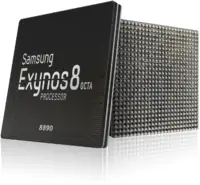
Exynos 8890 (8 Octa) is a 64-bit octa-core high-performance mobile SoC designed by Samsung and introduced in early 2016 for their consumer electronics.
Manufactured on Samsung's 2nd generation 14 nm process, the 8890 features eight cores consisting of a big quad-core cluster operating at 2.3 GHz with a turbo of up to 2.6 GHz based on Samsung's custom Mongoose 1 microarchitecture and another little quad-core cluster operating at 1.6 GHz consisting of Cortex-A53 cores.
This chip supports up to 4 GiB of dual-channel 32-bit LPDDR4-3600 memory and incorporates a Mali-T880 MP12 GPU operating at 650 MHz. The 8890 incorporates an LTE modem supporting Cat. 12 download and Cat. 13 upload.
Contents
Overview[edit]
The Exynos 8890 (8 Octa) is the first microprocessor that includes Samsung's first custom cores based on the Mongoose 1 microarchitecture. Those cores are said to provide over 30% higher performance and 10% lower power compared to the Exynos 7870 (7 Octa). The chip features two quad-core clusters. The first one is the high-performance Mongoose 1 core cluster and a second low-power Cortex-A53 core cluster. Communication is done over Samsung's cache-coherent Coherent Interconnect (SCI).
Features[edit]
[Edit/Modify Supported Features]
 |
Supported ARM Extensions & Processor Features
|
|||||||
|
||||||||
Wireless[edit]
 Wireless Communications Wireless Communications | |||||||
| Cellular | |||||||
| 4G |
| ||||||
|---|---|---|---|---|---|---|---|
Cache[edit]
- Main articles: Mongoose 1 § Cache and Cortex-A53 § Cache
For the Mongoose 1 core cluster:
 |
Cache Organization
Cache is a hardware component containing a relatively small and extremely fast memory designed to speed up the performance of a CPU by preparing ahead of time the data it needs to read from a relatively slower medium such as main memory. The organization and amount of cache can have a large impact on the performance, power consumption, die size, and consequently cost of the IC. Cache is specified by its size, number of sets, associativity, block size, sub-block size, and fetch and write-back policies. Note: All units are in kibibytes and mebibytes. |
||||||||||||||||||||||||
|
|||||||||||||||||||||||||
For the Cortex-A53 cluster:
|
Cache Organization
Cache is a hardware component containing a relatively small and extremely fast memory designed to speed up the performance of a CPU by preparing ahead of time the data it needs to read from a relatively slower medium such as main memory. The organization and amount of cache can have a large impact on the performance, power consumption, die size, and consequently cost of the IC. Cache is specified by its size, number of sets, associativity, block size, sub-block size, and fetch and write-back policies. Note: All units are in kibibytes and mebibytes. |
||||||||||||||||||||||||
|
|||||||||||||||||||||||||
Memory controller[edit]
 |
Integrated Memory Controller
|
|||||||||||||||
|
||||||||||||||||
Graphics[edit]
 |
Integrated Graphics Information
|
|||||||||||||||||||||||||||||
|
||||||||||||||||||||||||||||||
| Codec | Encode | Decode |
|---|---|---|
| HEVC (H.265) | ✔ | ✔ |
| MPEG-4 AVC (H.264) | ✔ | ✔ |
| VP9 | ✔ | ✔ |
All at 4K UHD 60fps.
Utilizing devices[edit]
- Samsung Galaxy S7 SM-G930F
- Samsung Galaxy S7 SM-G930FD
- Samsung Galaxy S7 SM-G930S
- Samsung Galaxy S7 SM-G930K
- Samsung Galaxy S7 SM-G930L
- Samsung Galaxy S7 SM-G930W8
- Samsung Galaxy S7 Edge SM-G935F
- Samsung Galaxy S7 Edge SM-G935FD
- Samsung Galaxy S7 Edge SM-G935S
- Samsung Galaxy S7 Edge SM-G935K
- Samsung Galaxy S7 Edge SM-G935L
- Samsung Galaxy Note 7 SM-N930F
- Samsung Galaxy Note 7 SM-N930FD
- Samsung Galaxy Note 7 SM-N930S
- Samsung Galaxy Note 7 SM-N930K
- Samsung Galaxy Note 7 SM-N930L
- Samsung Galaxy Note Fan Edition
- MicroVision MV 8890-LCD (SBC)
- Meizu Pro 6 Plus (64/128 GB)
This list is incomplete; you can help by expanding it.
Documents[edit]
| base frequency | 2,300 MHz (2.3 GHz, 2,300,000 kHz) + and 1,600 MHz (1.6 GHz, 1,600,000 kHz) + |
| core count | 8 + |
| core name | Mongoose 1 + and Cortex-A53 + |
| designer | Samsung + |
| family | Exynos + |
| first announced | November 12, 2015 + |
| first launched | February 21, 2016 + |
| full page name | samsung/exynos/8890 + |
| has 4g support | true + |
| has ecc memory support | false + |
| has lte advanced support | true + |
| instance of | microprocessor + |
| integrated gpu | Mali-T880 + |
| integrated gpu base frequency | 650 MHz (0.65 GHz, 650,000 KHz) + |
| integrated gpu designer | ARM Holdings + |
| integrated gpu execution units | 12 + |
| isa | ARMv8 + |
| isa family | ARM + |
| l1$ size | 384 KiB (393,216 B, 0.375 MiB) + and 256 KiB (262,144 B, 0.25 MiB) + |
| l1d$ description | 8-way set associative + and 4-way set associative + |
| l1d$ size | 128 KiB (131,072 B, 0.125 MiB) + |
| l1i$ description | 4-way set associative + and 2-way set associative + |
| l1i$ size | 256 KiB (262,144 B, 0.25 MiB) + and 128 KiB (131,072 B, 0.125 MiB) + |
| l2$ description | 16-way set associative + |
| l2$ size | 2 MiB (2,048 KiB, 2,097,152 B, 0.00195 GiB) + and 0.25 MiB (256 KiB, 262,144 B, 2.441406e-4 GiB) + |
| ldate | February 21, 2016 + |
| main image |  + + |
| manufacturer | Samsung + |
| market segment | Mobile + |
| max cpu count | 1 + |
| max memory | 4,096 MiB (4,194,304 KiB, 4,294,967,296 B, 4 GiB, 0.00391 TiB) + |
| max memory channels | 2 + |
| microarchitecture | Mongoose 1 + and Cortex-A53 + |
| model number | 8890 + |
| name | Exynos 8890 + |
| process | 14 nm (0.014 μm, 1.4e-5 mm) + |
| series | Exynos 8 + |
| smp max ways | 1 + |
| supported memory type | LPDDR4-3600 + |
| technology | CMOS + |
| thread count | 8 + |
| turbo frequency | 2,600 MHz (2.6 GHz, 2,600,000 kHz) + |
| turbo frequency (1 core) | 2,600 MHz (2.6 GHz, 2,600,000 kHz) + |
| turbo frequency (2 cores) | 2,600 MHz (2.6 GHz, 2,600,000 kHz) + |
| turbo frequency (3 cores) | 2,300 MHz (2.3 GHz, 2,300,000 kHz) + |
| turbo frequency (4 cores) | 2,300 MHz (2.3 GHz, 2,300,000 kHz) + |
| used by | Samsung Galaxy S7 SM-G930F +, Samsung Galaxy S7 SM-G930FD +, Samsung Galaxy S7 SM-G930S +, Samsung Galaxy S7 SM-G930K +, Samsung Galaxy S7 SM-G930L +, Samsung Galaxy S7 SM-G930W8 +, Samsung Galaxy S7 Edge SM-G935F +, Samsung Galaxy S7 Edge SM-G935FD +, Samsung Galaxy S7 Edge SM-G935S +, Samsung Galaxy S7 Edge SM-G935K +, Samsung Galaxy S7 Edge SM-G935L +, Samsung Galaxy Note 7 SM-N930F +, Samsung Galaxy Note 7 SM-N930FD +, Samsung Galaxy Note 7 SM-N930S +, Samsung Galaxy Note 7 SM-N930K +, Samsung Galaxy Note 7 SM-N930L +, Samsung Galaxy Note Fan Edition +, MicroVision MV 8890-LCD + and Meizu Pro 6 Plus + |
| user equipment category downlink | 12 + |
| user equipment category uplink | 13 + |
| word size | 64 bit (8 octets, 16 nibbles) + |
