
Semiconductor & Computer Engineering
(note 7 model numbers amendment) |
(fixed) |
||
| Line 1: | Line 1: | ||
| − | {{samsung title|Exynos | + | {{samsung title|Exynos 8890}} |
{{chip | {{chip | ||
| − | |name=Exynos | + | |name=Exynos 8890 |
|image=exynos 8 octa.png | |image=exynos 8 octa.png | ||
|designer=Samsung | |designer=Samsung | ||
| Line 22: | Line 22: | ||
|microarch=Mongoose 1 | |microarch=Mongoose 1 | ||
|microarch 2=Cortex-A53 | |microarch 2=Cortex-A53 | ||
| − | |core name= | + | |core name=Mongoose 2 |
|core name 2=Cortex-A53 | |core name 2=Cortex-A53 | ||
|process=14 nm | |process=14 nm | ||
| Line 36: | Line 36: | ||
|successor link=samsung/exynos/8895 | |successor link=samsung/exynos/8895 | ||
}} | }} | ||
| − | '''Exynos 8 Octa | + | '''Exynos 8890''' ('''8 Octa''') is a {{arch|64}} [[octa-core]] high-performance mobile SoC designed by [[Samsung]] and introduced in early [[2016]] for their consumer electronics. |
| + | |||
| + | Manufactured on Samsung's 2nd generation [[14 nm process]], the 8890 features [[eight cores]] consisting of a [[big core|big]] quad-core cluster operating at 2.3 GHz with a turbo of up to 2.6 GHz based on [[Samsung]]'s custom {{samsung|Mongoose 1|l=arch}} microarchitecture and another [[little core|little]] quad-core cluster operating at 1.6 GHz consisting of {{armh|Cortex-A53|l=arch}} cores. | ||
| + | |||
| + | This chip supports up to 4 GiB of dual-channel 32-bit LPDDR4-3600 memory and incorporates a {{armh|Mali-T880}} MP12 GPU operating at 650 MHz. The 8890 incorporates an LTE modem supporting Cat. 12 download and Cat. 13 upload. | ||
== Overview == | == Overview == | ||
| − | The Exynos 8 Octa is the first microprocessor that includes Samsung's first custom cores based on the {{samsung|Mongoose 1|l=arch}} microarchitecture. Those cores are said to provide over 30% higher performance and 10% lower power compared to the [[Exynos 7 Octa]]. The chip features two [[quad-core]] clusters. The first one is the high-performance {{samsung|Mongoose 1|l=arch}} core cluster and a second low-power {{armh|Cortex-A53|l=arch}} core cluster. Communication is done over Samsung's cache-coherent {{samsung|Coherent Interconnect}} (SCI). | + | The Exynos 8890 (8 Octa) is the first microprocessor that includes [[Samsung]]'s first custom cores based on the {{samsung|Mongoose 1|l=arch}} microarchitecture. Those cores are said to provide over 30% higher performance and 10% lower power compared to the [[Exynos 7 Octa]]. The chip features two [[quad-core]] clusters. The first one is the high-performance {{samsung|Mongoose 1|l=arch}} core cluster and a second low-power {{armh|Cortex-A53|l=arch}} core cluster. Communication is done over Samsung's cache-coherent {{samsung|Coherent Interconnect}} (SCI). |
| + | |||
| + | == Features == | ||
| + | {{arm features | ||
| + | |thumb=No | ||
| + | |thumb2=No | ||
| + | |thumbee=No | ||
| + | |vfpv1=No | ||
| + | |vfpv2=No | ||
| + | |vfpv3=No | ||
| + | |vfpv3-d16=No | ||
| + | |vfpv3-f16=No | ||
| + | |vfpv4=No | ||
| + | |vfpv4-d16=No | ||
| + | |vfpv5=No | ||
| + | |neon=Yes | ||
| + | |trustzone=No | ||
| + | |jazelle=No | ||
| + | |wmmx=No | ||
| + | |wmmx2=No | ||
| + | |pmuv3=No | ||
| + | |crc32=Yes | ||
| + | |crypto=Yes | ||
| + | |fp=Yes | ||
| + | |fp16=No | ||
| + | |profile=No | ||
| + | |ras=No | ||
| + | |simd=No | ||
| + | |rdm=No | ||
| + | }} | ||
| + | |||
| + | == Wireless == | ||
| + | {{wireless links | ||
| + | | 2g = | ||
| + | | csd = | ||
| + | | gsm = | ||
| + | | gprs = | ||
| + | | edge = | ||
| + | | cdmaone = | ||
| + | | is-95a = | ||
| + | | is-95b = | ||
| + | | 3g = | ||
| + | | cdma2000 = | ||
| + | | cdma2000 1x = | ||
| + | | cdma2000 1xev-do = | ||
| + | | cdma2000 1x adv = | ||
| + | | umts = | ||
| + | | wcdma = | ||
| + | | td-scdma = | ||
| + | | dc-hsdpa = | ||
| + | | hsdpa = | ||
| + | | hsupa = | ||
| + | | 4g = Yes | ||
| + | | lte a = Yes | ||
| + | | e-utran = | ||
| + | | ue cat dl = 12 | ||
| + | | ue cat dl rate = 600 Mbps | ||
| + | | ue cat ul = 13 | ||
| + | | ue cat ul rate = 150 Mbps | ||
| + | }} | ||
== Cache == | == Cache == | ||
| Line 135: | Line 198: | ||
All at 4K UHD 60fps. | All at 4K UHD 60fps. | ||
| − | |||
| − | |||
| − | |||
| − | |||
| − | |||
| − | |||
| − | |||
| − | |||
| − | |||
| − | |||
| − | |||
| − | |||
| − | |||
| − | |||
| − | |||
| − | |||
| − | |||
| − | |||
| − | |||
| − | |||
| − | |||
| − | |||
| − | |||
| − | |||
| − | |||
| − | |||
| − | |||
| − | |||
| − | |||
| − | |||
| − | |||
| − | |||
| − | |||
| − | |||
| − | |||
| − | |||
| − | |||
| − | |||
| − | |||
| − | |||
| − | |||
| − | |||
| − | |||
| − | |||
| − | |||
| − | |||
| − | |||
| − | |||
| − | |||
| − | |||
| − | |||
| − | |||
| − | |||
| − | |||
| − | |||
| − | |||
| − | |||
| − | |||
| − | |||
== Utilizing devices == | == Utilizing devices == | ||
| Line 218: | Line 222: | ||
* [[used by::MicroVision MV 8890-LCD]] | * [[used by::MicroVision MV 8890-LCD]] | ||
* [[used by::Meizu Pro 6 Plus]] | * [[used by::Meizu Pro 6 Plus]] | ||
| + | |||
{{expand list}} | {{expand list}} | ||
== Documents == | == Documents == | ||
| − | * [[:File:exynos 8 octa.pdf|Exynos 8 Octa Product Brief]] | + | * [[:File:exynos 8 octa.pdf|Exynos 8890 (8 Octa) Product Brief]] |
Revision as of 13:34, 22 January 2026
| Edit Values | |
| Exynos 8890 | |
 | |
| General Info | |
| Designer | Samsung |
| Manufacturer | Samsung |
| Model Number | 8890 |
| Market | Mobile |
| Introduction | November 12, 2015 (announced) February 21, 2016 (launched) |
| General Specs | |
| Family | Exynos |
| Series | Exynos 8 |
| Frequency | 2,300 MHz, 1,600 MHz |
| Turbo Frequency | 2,600 MHz |
| Turbo Frequency | 2,600 MHz (1 core), 2,600 MHz (2 cores), 2,300 MHz (3 cores), 2,300 MHz (4 cores) |
| Microarchitecture | |
| ISA | ARMv8 (ARM) |
| Microarchitecture | Mongoose 1, Cortex-A53 |
| Core Name | Mongoose 2, Cortex-A53 |
| Process | 14 nm |
| Technology | CMOS |
| Word Size | 64 bit |
| Cores | 8 |
| Threads | 8 |
| Max Memory | 4 GiB |
| Multiprocessing | |
| Max SMP | 1-Way (Uniprocessor) |
| Succession | |
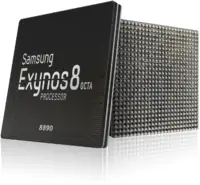
Exynos 8890 (8 Octa) is a 64-bit octa-core high-performance mobile SoC designed by Samsung and introduced in early 2016 for their consumer electronics.
Manufactured on Samsung's 2nd generation 14 nm process, the 8890 features eight cores consisting of a big quad-core cluster operating at 2.3 GHz with a turbo of up to 2.6 GHz based on Samsung's custom Mongoose 1 microarchitecture and another little quad-core cluster operating at 1.6 GHz consisting of Cortex-A53 cores.
This chip supports up to 4 GiB of dual-channel 32-bit LPDDR4-3600 memory and incorporates a Mali-T880 MP12 GPU operating at 650 MHz. The 8890 incorporates an LTE modem supporting Cat. 12 download and Cat. 13 upload.
Contents
Overview
The Exynos 8890 (8 Octa) is the first microprocessor that includes Samsung's first custom cores based on the Mongoose 1 microarchitecture. Those cores are said to provide over 30% higher performance and 10% lower power compared to the Exynos 7 Octa. The chip features two quad-core clusters. The first one is the high-performance Mongoose 1 core cluster and a second low-power Cortex-A53 core cluster. Communication is done over Samsung's cache-coherent Coherent Interconnect (SCI).
Features
[Edit/Modify Supported Features]
 |
Supported ARM Extensions & Processor Features
|
|||||||
|
||||||||
Wireless
 Wireless Communications Wireless Communications | |||||||
| Cellular | |||||||
| 4G |
| ||||||
|---|---|---|---|---|---|---|---|
Cache
- Main articles: Mongoose 1 § Cache and Cortex-A53 § Cache
For the Mongoose 1 core cluster:
 |
Cache Organization
Cache is a hardware component containing a relatively small and extremely fast memory designed to speed up the performance of a CPU by preparing ahead of time the data it needs to read from a relatively slower medium such as main memory. The organization and amount of cache can have a large impact on the performance, power consumption, die size, and consequently cost of the IC. Cache is specified by its size, number of sets, associativity, block size, sub-block size, and fetch and write-back policies. Note: All units are in kibibytes and mebibytes. |
||||||||||||||||||||||||
|
|||||||||||||||||||||||||
For the Cortex-A53 cluster:
|
Cache Organization
Cache is a hardware component containing a relatively small and extremely fast memory designed to speed up the performance of a CPU by preparing ahead of time the data it needs to read from a relatively slower medium such as main memory. The organization and amount of cache can have a large impact on the performance, power consumption, die size, and consequently cost of the IC. Cache is specified by its size, number of sets, associativity, block size, sub-block size, and fetch and write-back policies. Note: All units are in kibibytes and mebibytes. |
||||||||||||||||||||||||
|
|||||||||||||||||||||||||
Memory controller
 |
Integrated Memory Controller
|
|||||||||||||||
|
||||||||||||||||
Graphics
 |
Integrated Graphics Information
|
|||||||||||||||||||||||||||||
|
||||||||||||||||||||||||||||||
| Codec | Encode | Decode |
|---|---|---|
| HEVC (H.265) | ✔ | ✔ |
| MPEG-4 AVC (H.264) | ✔ | ✔ |
| VP9 | ✔ | ✔ |
All at 4K UHD 60fps.
Utilizing devices
- Samsung Galaxy Note 7 SM-N930F
- Samsung Galaxy Note 7 SM-N930FD
- Samsung Galaxy Note 7 SM-N930S
- Samsung Galaxy Note 7 SM-N930K
- Samsung Galaxy Note 7 SM-N930L
- Samsung Galaxy Note Fan Edition
- Samsung Galaxy S7 SM-G930F
- Samsung Galaxy S7 SM-G930FD
- Samsung Galaxy S7 SM-G930S
- Samsung Galaxy S7 SM-G930K
- Samsung Galaxy S7 SM-G930L
- Samsung Galaxy S7 SM-G930W8
- Samsung Galaxy S7 Edge SM-G935F
- Samsung Galaxy S7 Edge SM-G935FD
- Samsung Galaxy S7 Edge SM-G935S
- Samsung Galaxy S7 Edge SM-G935K
- Samsung Galaxy S7 Edge SM-G935L
- MicroVision MV 8890-LCD
- Meizu Pro 6 Plus
This list is incomplete; you can help by expanding it.
Documents
| base frequency | 2,300 MHz (2.3 GHz, 2,300,000 kHz) + and 1,600 MHz (1.6 GHz, 1,600,000 kHz) + |
| core count | 8 + |
| core name | Mongoose 2 + and Cortex-A53 + |
| designer | Samsung + |
| family | Exynos + |
| first announced | November 12, 2015 + |
| first launched | February 21, 2016 + |
| full page name | samsung/exynos/8890 + |
| has 4g support | true + |
| has ecc memory support | false + |
| has lte advanced support | true + |
| instance of | microprocessor + |
| integrated gpu | Mali-T880 + |
| integrated gpu base frequency | 600 MHz (0.6 GHz, 600,000 KHz) + |
| integrated gpu designer | ARM Holdings + |
| integrated gpu execution units | 12 + |
| isa | ARMv8 + |
| isa family | ARM + |
| l1$ size | 384 KiB (393,216 B, 0.375 MiB) + and 256 KiB (262,144 B, 0.25 MiB) + |
| l1d$ description | 8-way set associative + and 4-way set associative + |
| l1d$ size | 128 KiB (131,072 B, 0.125 MiB) + |
| l1i$ description | 4-way set associative + and 2-way set associative + |
| l1i$ size | 256 KiB (262,144 B, 0.25 MiB) + and 128 KiB (131,072 B, 0.125 MiB) + |
| l2$ description | 16-way set associative + |
| l2$ size | 2 MiB (2,048 KiB, 2,097,152 B, 0.00195 GiB) + and 0.25 MiB (256 KiB, 262,144 B, 2.441406e-4 GiB) + |
| ldate | February 21, 2016 + |
| main image |  + + |
| manufacturer | Samsung + |
| market segment | Mobile + |
| max cpu count | 1 + |
| max memory | 4,096 MiB (4,194,304 KiB, 4,294,967,296 B, 4 GiB, 0.00391 TiB) + |
| max memory channels | 2 + |
| microarchitecture | Mongoose 1 + and Cortex-A53 + |
| model number | 8890 + |
| name | Exynos 8890 + |
| process | 14 nm (0.014 μm, 1.4e-5 mm) + |
| series | Exynos 8 + |
| smp max ways | 1 + |
| supported memory type | LPDDR4-3600 + |
| technology | CMOS + |
| thread count | 8 + |
| turbo frequency | 2,600 MHz (2.6 GHz, 2,600,000 kHz) + |
| turbo frequency (1 core) | 2,600 MHz (2.6 GHz, 2,600,000 kHz) + |
| turbo frequency (2 cores) | 2,600 MHz (2.6 GHz, 2,600,000 kHz) + |
| turbo frequency (3 cores) | 2,300 MHz (2.3 GHz, 2,300,000 kHz) + |
| turbo frequency (4 cores) | 2,300 MHz (2.3 GHz, 2,300,000 kHz) + |
| used by | Samsung Galaxy Note 7 SM-N930F +, Samsung Galaxy Note 7 SM-N930FD +, Samsung Galaxy Note 7 SM-N930S +, Samsung Galaxy Note 7 SM-N930K +, Samsung Galaxy Note 7 SM-N930L +, Samsung Galaxy Note Fan Edition +, Samsung Galaxy S7 SM-G930F +, Samsung Galaxy S7 SM-G930FD +, Samsung Galaxy S7 SM-G930S +, Samsung Galaxy S7 SM-G930K +, Samsung Galaxy S7 SM-G930L +, Samsung Galaxy S7 SM-G930W8 +, Samsung Galaxy S7 Edge SM-G935F +, Samsung Galaxy S7 Edge SM-G935FD +, Samsung Galaxy S7 Edge SM-G935S +, Samsung Galaxy S7 Edge SM-G935K +, Samsung Galaxy S7 Edge SM-G935L +, MicroVision MV 8890-LCD + and Meizu Pro 6 Plus + |
| user equipment category downlink | 12 + |
| user equipment category uplink | 13 + |
| word size | 64 bit (8 octets, 16 nibbles) + |
